

Last Updated on December 20, 2024, 10:02 am ET
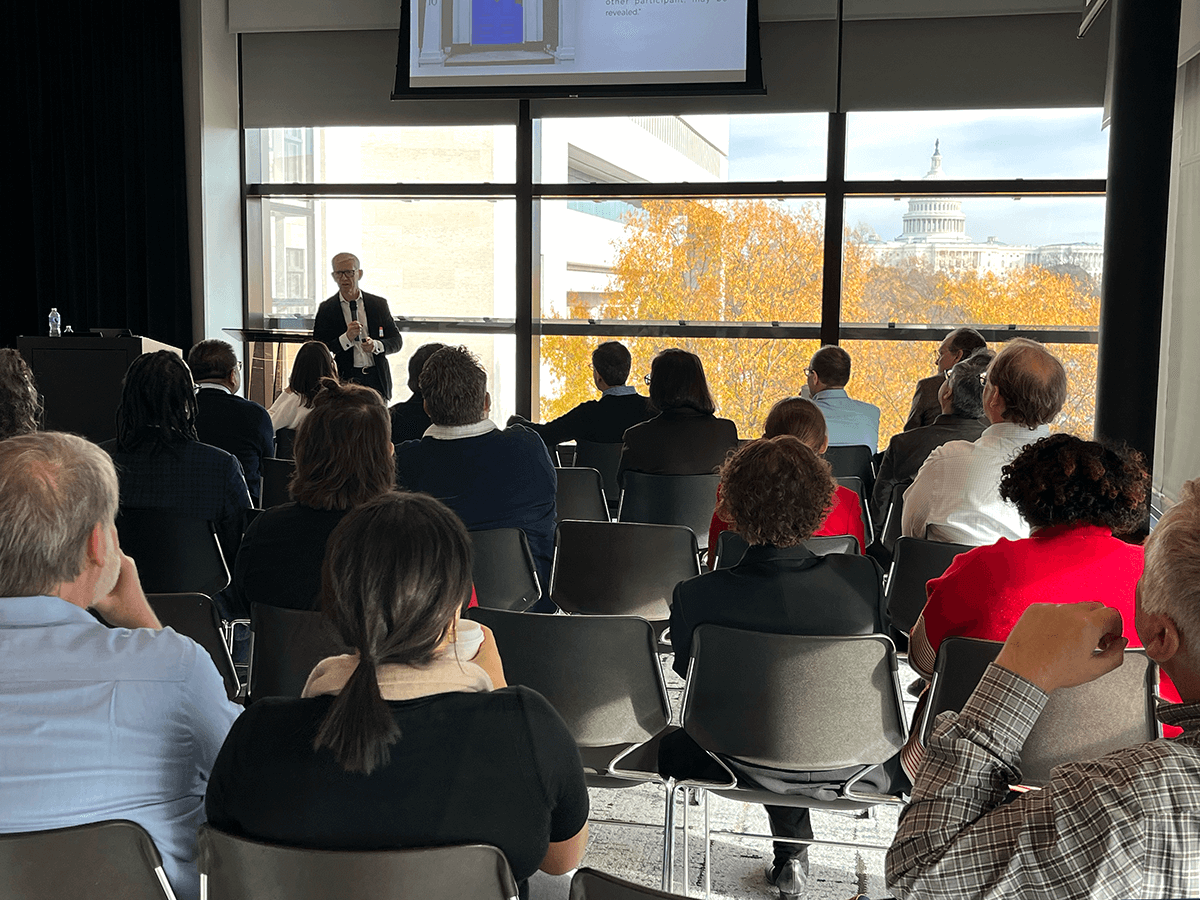
On December 7–8, library leaders from 22 institutions in the United States and Canada gathered at the Johns Hopkins University (JHU) Bloomberg Center in Washington, DC, for a national forum on the strategic implications of artificial intelligence for research libraries. The forum, which was hosted by Sheridan Libraries and supported by a grant from the Institute for Museum and Library Services, challenged participants to identify potential consequences, challenges, and opportunities arising from the ARL/CNI AI Scenarios, released earlier in 2024.
Facilitated by Keith Webster, dean of University Libraries at Carnegie Mellon University and a practicing futurist, the forum used interactive small-group discussions to surface key drivers of change and to develop organizational strategies that are adaptive and responsive to four possible AI futures. By mapping the impacts of these strategies and the effort likely to be involved in their execution, participants were able to define bold, concrete actions they could take in the near term.
When asked to evaluate the opportunities for strategic action identified during the forum, participants rated the following three areas most highly: investments in digital forensics to establish the provenance of human- and machine-generated content; workforce development, including how to recruit AI talent and foster a culture of upskilling; forging values-aligned partnerships both within universities and with the tech sector.
Stephen Betts, senior director, digital at the New York Public Library (NYPL), said, “The Futurescape Libraries national forum was extremely valuable for thinking through the implications of AI for research libraries. The presentations and exercises were engaging and well designed, sparking thought-provoking contributions and perspectives from the attendees. I particularly appreciated the distinct scenarios that were presented, each highlighting its own unique challenges. Reflecting on the potential roles libraries can play in these scenarios—and considering how we might influence which scenarios come to pass—will provide us at NYPL with much to consider as we continue to develop our AI strategy.”
“Our paradigm for information delivery in libraries needs to change,” said Jamie Wittenberg, assistant dean for research and innovation strategies at the University of Colorado Boulder University Libraries. “Over the last 30 years, libraries adapted to provision immediate, seamless access to the deluge of information made available on the open web. In a future where information is not just made available by machines but is synthesized by machines, there is an opportunity for libraries to reevaluate the utility of seamless access versus curated mediation and to resurface library and archival traditions like diplomatics to develop a strong value proposition as institutions that champion the verifiability of information.”
Weiwei Shi, associate university librarian at the University of Alberta, said, “I left the national forum both inspired and concerned. The fast pace of AI evolution challenges not only the operational speed of research libraries but also our comfort levels as professionals and members of society. I’m eager to help prepare our staff with the technological competencies to embrace these changes, while also working to craft a compelling narrative about the library’s relevance and invaluable role in the AI conversation—and the research enterprise as a whole.”
“One of the first things I plan to do [after attending the forum] is to review vendor expenditures for library services and identify areas where we’ve been holding on to library gateways with consistently low user engagement,” said Karen Estlund, dean of libraries at Colorado State University. “I hope to identify services to eliminate and then reinvest in AI. I am also pondering the exciting possibilities for libraries working together in areas where we have professional as well as technical expertise. Building on open-source community efforts, I want to explore how we can provide retrieval-augmented generation (RAG) models or agent tools to address and reframe biases in existing large language models, using our collections to power more inclusive AI tools.”
Building on the outcomes of the national forum, the Association of Research Libraries (ARL) is creating a free online toolkit enabling libraries of all types to apply the future scenarios in their local context. A series of three regional workshops will then focus on training additional research library leaders to use the toolkit at their home institutions in the context of strategic planning. Taken together, these activities stand to help libraries harness the power of futures thinking to be proactive, rather than reactive, in the face of social and technological change.