

Last Updated on June 14, 2024, 12:14 pm ET

At the Association of Research Libraries (ARL) Spring Meeting in Boston, library and information technology leaders explored and examined the recently released ARL/CNI 2035 Scenarios: AI-Influenced Futures in the Research Environment.
When utilizing scenarios for strategic planning, it is crucial not to focus narrowly on a single scenario. Instead, we consider a spectrum of scenarios that highlight the key uncertainties within the scholarly ecosystem. This approach does not assume that the future will unfold exactly as any particular scenario suggests; rather, it acknowledges that the actual future is likely to incorporate aspects from multiple scenarios and include unforeseen developments.
One component of the exploration conducted at the ARL Spring Meeting involved articulating and analyzing the strengths that research libraries have now, which are beneficial in each possible future. By surfacing library strengths in each scenario, we can better prepare to leverage these capabilities across varying future conditions, enhancing our adaptability and readiness. This method prevents rigid planning based on predictions and instead fosters a flexible strategy that can respond effectively to a diverse range of potential developments.
A summary of these strengths and the results of a member-wide poll for each scenario may be found below.
Scenario 1—Democratized and Socially Integrated AI
This scenario is a world in which an extraordinary convergence of advances in human-computer interfaces and AI technologies create an unprecedented integration of human and computational capabilities that flourish with increasingly open knowledge access. AI integrates with humans seamlessly, responsibly, and safely transforming research, knowledge development, collaboration, and communication.
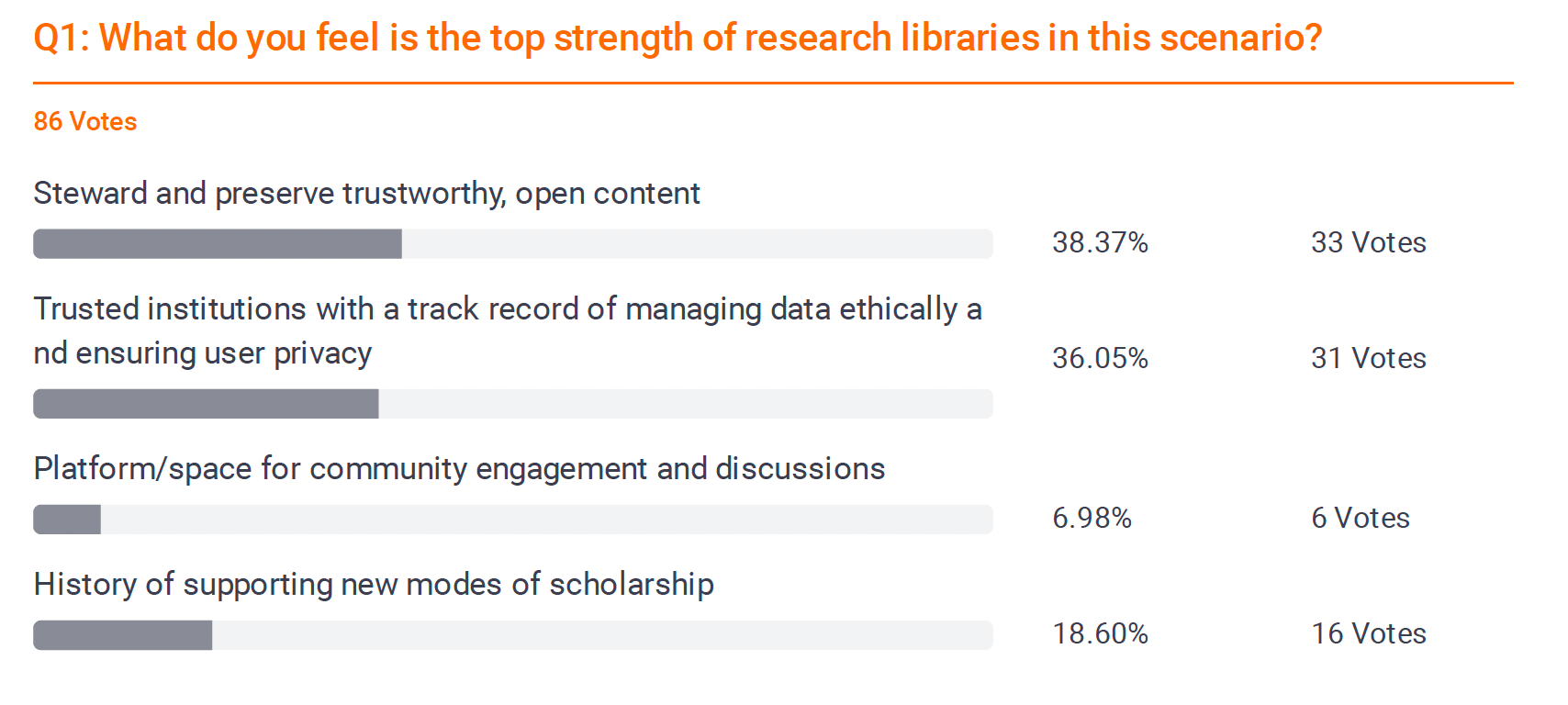
- Steward and Preserve Trustworthy, Open Content (38.4% of votes):
This was identified as the top strength. Libraries are seen as critical stewards of open and reliable content, which aligns well with the scenario’s emphasis on open access and transparency. This role is crucial in maintaining the integrity of the information ecosystem, especially when AI technologies are integrated deeply into research and learning processes. - Trusted Institutions with a Track Record of Managing Data Ethically and Ensuring User Privacy (36.0% of votes):
Nearly as many respondents identified this as a core strength, reflecting the high value placed on privacy and ethics in data management. This strength is particularly important in a future where research libraries handle more complex and sensitive data, necessitating robust privacy protections and ethical guidelines to foster trust and safeguard user information. - History of Supporting New Modes of Scholarship (18.6% of votes):
This strength reflects the adaptability of libraries to evolving research methodologies, which is essential in a scenario dominated by AI-driven changes in how research is conducted. The ability to support new modes of scholarship enables libraries to stay relevant and effective as central hubs in the research community. - Platform/Space for Community Engagement and Discussions (7.0% of votes):
While seen as less of a strength compared to others, the role of libraries as platforms for community engagement is still significant. This facet will likely grow in importance as AI technologies foster more collaborative and interdisciplinary research approaches.
Overall, the poll indicates that research libraries are pivotal entities in managing and disseminating knowledge responsibly in this AI-enhanced future. Their role in upholding ethical standards and ensuring open access to information is particularly valued, aligning with societal needs for trust and integrity in the age of AI.
Scenario 2—Consumer-Oriented AI Focused on Education and Entertainment
This scenario is a world in which AI’s impact on the research and knowledge ecosystem is relatively low with the primary AI advances and impact being seen in consumer applications that are readily profitable, relatively uncontroversial, and lower-barrier applications. Tech giants drive innovation in the interaction of individuals with each other and around real, virtual, and hybrid worlds that leverage AI to create enhanced environments and experiences.
The poll results indicate how research libraries perceive their strengths in a world where AI has primarily impacted consumer applications, with relatively lower influence in the research and knowledge ecosystem.
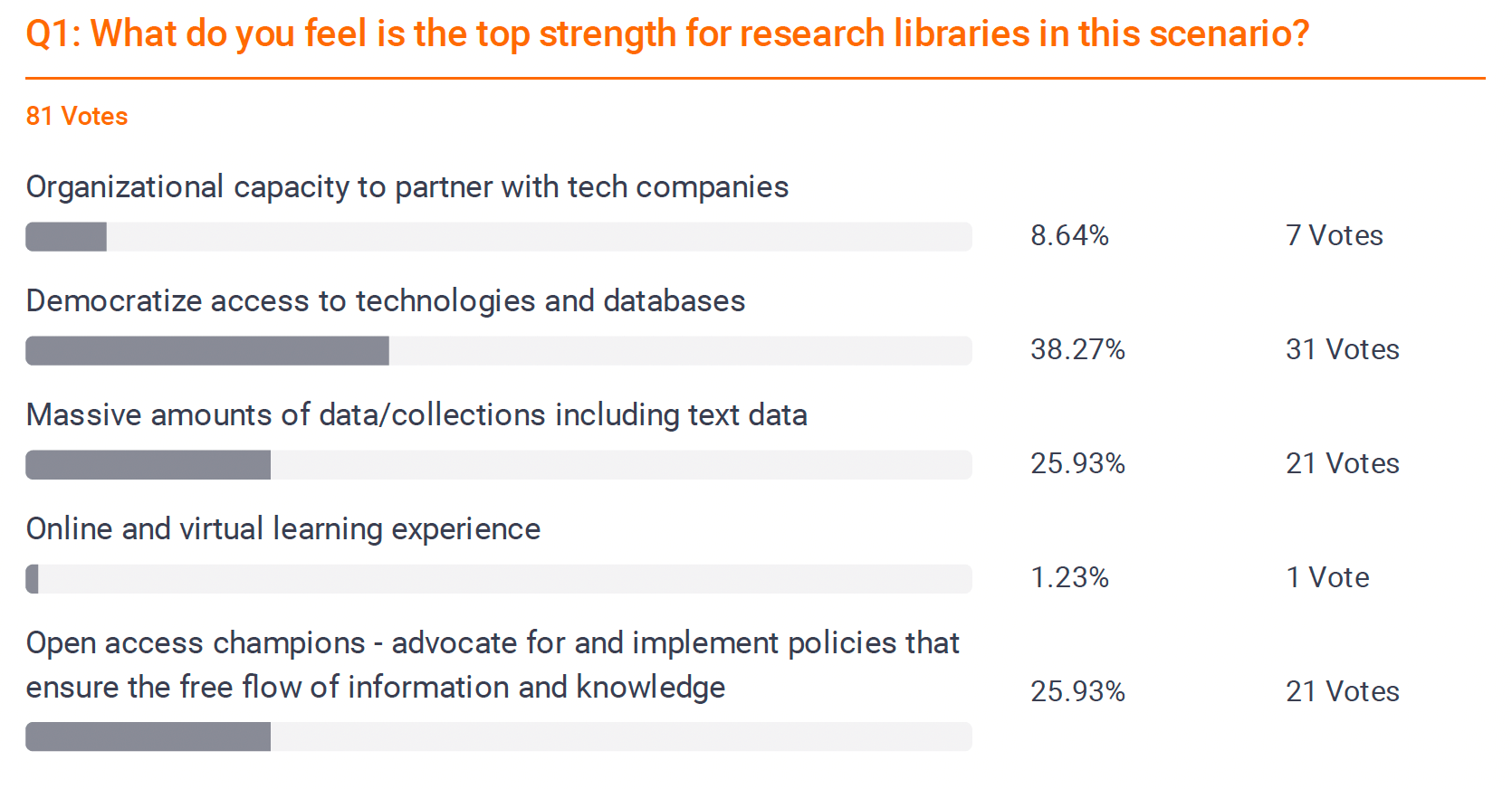
- Democratize Access to Technologies and Databases (38.3% of votes):
This was viewed as the top strength, reflecting the crucial role research libraries play in providing equitable access to advanced technologies and databases. In a scenario where tech companies dominate AI advancements, libraries serve as vital institutions that can bridge access gaps and ensure that various sectors of society benefit from technological advances. - Massive Amounts of Data/Collections Including Text Data (25.9% of votes):
Holding a substantial amount of data and collections places research libraries in a strong position to support research despite the dominance of tech companies. This strength allows them to support diverse scholarly activities and provide vast resources for academic and personal research, which is critical when access might be otherwise limited to elite entities. - Open Access Champions – Advocate for and Implement Policies that Ensure the Free Flow of Information and Knowledge (25.9% of votes):
Similarly important is the role of libraries as champions of open access. This role is particularly crucial in a scenario where access to AI-driven research tools and databases could be restricted by commercial interests. Libraries advocating for open access help ensure that knowledge remains a public good, accessible to all, rather than a commodity controlled by a few. - Organizational Capacity to Partner with Tech Companies (8.6% of votes):
While not seen as the top strength, the ability to partner with tech companies is recognized. This capacity can facilitate the integration of the latest technologies within library services and operations, enhancing their ability to serve their users effectively in an AI-influenced landscape. - Online and Virtual Learning Experience (1.2% of votes):
Surprisingly, this was seen as the least strength, possibly reflecting that in a scenario dominated by tech company innovations in consumer markets, libraries may feel less equipped to compete or lead in delivering online and virtual learning experiences compared to other strengths like data access and open advocacy.
Overall, the poll underscores the perception that research libraries must focus on democratizing access, managing extensive data collections, and championing open access to maintain their relevance and utility in a scenario where AI’s impact on research is limited and controlled by private interests.
Scenario 3—Laissez-Faire AI
This scenario is a world of missed opportunities, bad decisions, and fecklessness, punctuated by a somewhat haphazard assortment of commercial or other kinds of successes. The excitement and hype around AI and the belief that AI will solve the world’s most difficult problems result in an overzealous and hasty adoption of AI in both consumer life and professional and societal applications. Some AI applications incorporating egregious bias or dysfunction were deployed, leading to predictably bad outcomes, loss of trust, and poorly thought-out regulation; the overall environment is also vulnerable to deliberate manipulation and introduction of misinformation by bad actors both foreign and domestic.
Overall, the poll results provide insights into how research libraries view their strengths in a world characterized by poorly managed AI adoption and significant societal and technological challenges.

- Memory Institutions that Steward and Preserve Trustworthy, Open Content (29.3% of votes):
This was identified as a top strength, alongside democratizing access to technology. In a scenario filled with misinformation and low information integrity, the role of libraries as trustworthy repositories of information is crucial. Libraries preserve the integrity and accessibility of content, which is invaluable in an environment where data breaches and the resale of consumer data are rampant. - Democratize Access to Technologies and Databases (29.3% of votes):
Equally regarded as a top strength, democratizing access underscores the library’s role in providing equitable access to technologies and databases. This is especially critical in a setting where AI applications are embedded in societal systems, and there is a clear divide in technology access and literacy. Libraries act as equalizers, ensuring that all segments of the population can access necessary technological resources. - Serve as Inclusive Zones for Access to Global Research and Information (17.1% of votes):
Libraries serving as inclusive zones is seen as a significant strength, reflecting their role in offering access to global research and information. This function is vital for ensuring that diverse communities can stay informed and engage with global discourse, particularly when national and global tensions are heightened. - Leverage Robust Library Community to Share Best Practices for Crisis and Risk Management Related to Information and Technology (13.4% of votes):
The ability to leverage a community to share crisis and risk management practices is critical, given the scenario’s backdrop of frequent crises stemming from AI misuse. Libraries can serve as hubs for knowledge sharing and developing strategies to mitigate the risks associated with technological exploitation and data mismanagement. - Deliver Educational Programs and Workshops to Increase Literacy (11.0% of votes):
While this was seen as the least of the strengths, it remains important. Education and workshops to increase literacy are crucial in a world where general technology literacy is low and there’s a need for improved understanding of AI and its impacts. This role of libraries in education and literacy enhancement is essential for empowering the public to navigate and potentially mitigate the challenges posed by pervasive AI technologies.
The poll highlights that research libraries are critical institutions in maintaining the integrity of information, democratizing access to technology, and serving as educational and inclusive centers in a society grappling with the consequences of unregulated AI expansion and associated challenges.
Scenario 4—Autonomous AI
This scenario is a world in which AI is becoming an increasingly independent partner and collaborator in research and learning, leveraging the expanding open resources and data, and also exploiting the scarcity and high cost of human resources. Knowledge advances rapidly well beyond the research advances possible by humans. Society has adapted to a world enhanced by AI in all aspects of life and experience and in the process has knowingly and unknowingly given up increasing agency to AI.
The poll results shed light on how research libraries view their strengths in a world where AI is an increasingly independent actor in research and learning, as described in Scenario 4. Here’s a brief analysis of the results:
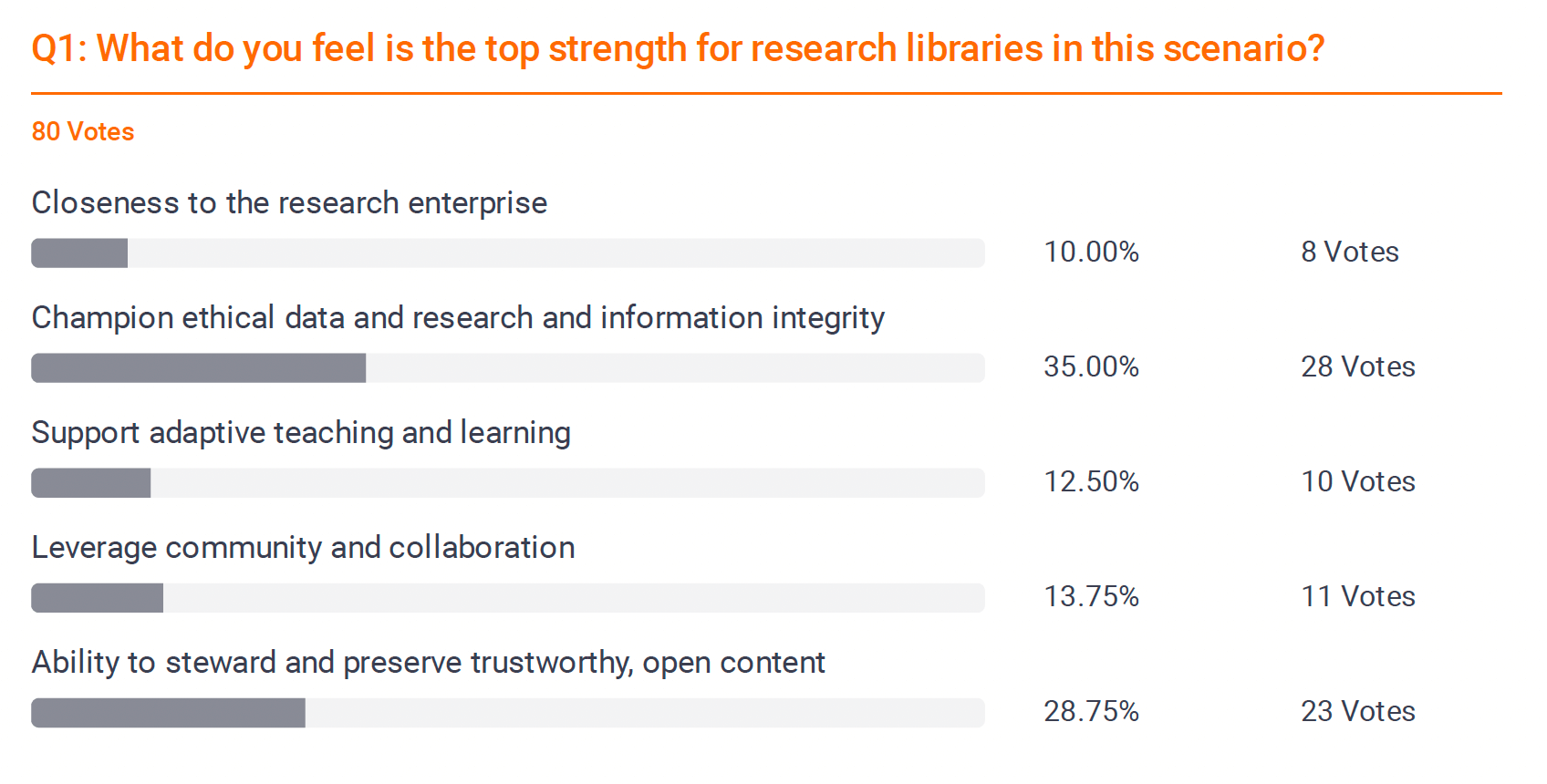
- Champion Ethical Data and Research and Information Integrity (35.0% of votes):
Being a champion of ethical data and research integrity is considered the top strength of research libraries in this scenario. Given the pervasive role of AI, ensuring the integrity and ethics of data and research is crucial. Libraries are seen as essential guardians in a landscape where AI’s expanding autonomy could potentially compromise data integrity and ethical standards. - Ability to Steward and Preserve Trustworthy, Open Content (28.8% of votes):
Close behind is the role of libraries in stewarding and preserving trustworthy, open content. This function remains critically important in maintaining a reliable knowledge base, especially as AI systems potentially create both open and proprietary knowledge repositories. Libraries ensure that access to knowledge remains open and that content is preserved against the risks of digital obsolescence or manipulation. - Leverage Community and Collaboration (13.8% of votes):
Leveraging community and collaboration is also seen as a significant strength. In a world increasingly driven by AI, the ability of libraries to foster collaboration not only among humans but between human and AI entities is valuable. This role helps integrate diverse insights and ensures that the knowledge ecosystem remains inclusive and multifaceted. - Support Adaptive Teaching and Learning (12.5% of votes):
Supporting adaptive teaching and learning is recognized as another key strength. As AI transforms educational methodologies, libraries play a crucial role in adapting these resources to support diverse learning environments and needs, helping learners and researchers keep pace with technological advancements. - Closeness to the Research Enterprise (10.0% of votes):
Lastly, the closeness of libraries to the research enterprise, while not viewed as the strongest asset, is still notable. This proximity allows libraries to be directly involved in the research process, facilitating immediate access to research tools and data, and ensuring that library services are aligned with the evolving needs of the research community.
Overall, the poll indicates that in a future where AI deeply permeates the research landscape, research libraries are valued for their ethical stewardship, preservation of open and trustworthy content, and their ability to facilitate community collaboration and support adaptive learning. These roles are crucial in ensuring that the integration of AI into research and learning enhances rather than undermines the integrity and accessibility of knowledge.
The poll results from the ARL/CNI 2035 Scenarios exploration reveal diverse strengths that research libraries can harness as they navigate AI-influenced futures. These strengths underscore libraries’ vital role in maintaining information integrity and ensuring equitable access amidst the challenges posed by AI advancements. For libraries, these insights emphasize the importance of continuing to build on these core competencies while staying adaptive and responsive to emerging technological trends. Leveraging the ARL/CNI 2035 Scenarios and continued attention to the broader strategic landscape will enable libraries to be proactive and remain relevant and effective as custodians of knowledge in an increasingly digital and AI-driven world.