
Last Updated on January 31, 2025, 10:00 am ET
If you’ve ever read through a library e-resource license agreement, you know it can feel like wading through legal quicksand. That’s why a team of library licensing experts and the Association of Research Libraries (ARL) launched an essential new resource to help libraries preserve digital access rights for their users, e-Resource Licensing Explained: An A–Z Licensing Guidebook for Libraries, as an open access e-book during Copyright Week. The guidebook is also available through a print-on-demand option. The book addresses multiple legal aspects of license agreements, including accessibility requirements, privacy protections, copyright, general contractual obligations, text and data mining, and more.
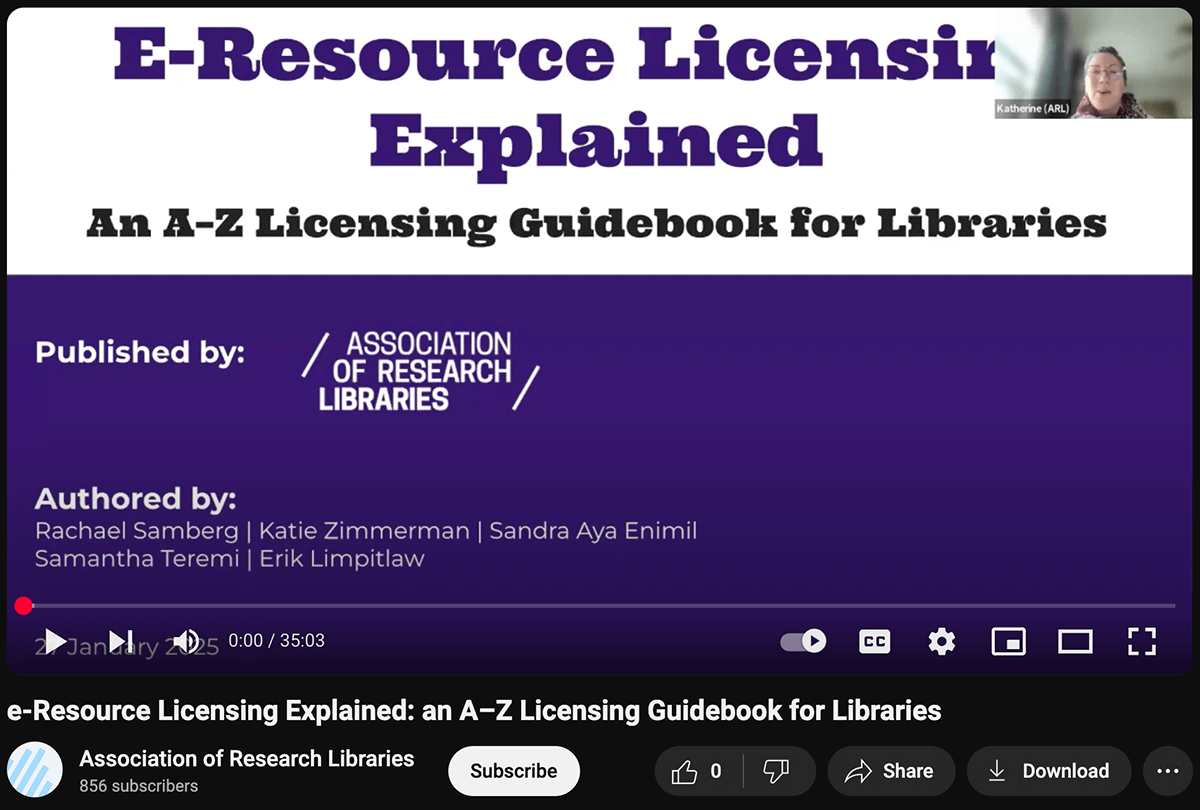
The book’s authors are:
- Sandra Aya Enimil, Director of Scholarly Communication and Collection Strategy, Yale Library
- Rachael Samberg, Director, Scholarly Communication & Information Policy, UC Berkeley Library
- Erik Limpitlaw, Digital Collections Licensing Librarian, Stanford University Libraries
- Samantha Teremi, Licensing Librarian, UC Berkeley Library
- Katie Zimmerman, Director of Copyright Strategy, MIT Libraries
Focus on Fair Use
e-Resource Licensing Explained tackles a pressing challenge facing libraries today: how to preserve researchers’ fair use rights when license agreements threaten to override them.
“The problem that US scholarly authors face with AI training is that publishers restrict their access to these statutory rights through contracts,” explains Rachael Samberg, director of Scholarly Communication and Information Policy at UC Berkeley Library. “In the United States, publishers can use private contracts to take away statutory fair use rights that researchers would otherwise hold under federal law.”
This contractual override problem puts US researchers at a distinct disadvantage. “More than 40 countries, including those in the European Union, expressly reserve text and data mining and AI training rights for scientific research conducted by research institutions,” Samberg notes. “Not only do scholars in research institutions in these countries not have to worry about whether their computational research with AI is permitted, but also they don’t have to risk having those rights overridden by contract.”
The guidebook authors emphasize that protecting fair use through careful licensing is essential for enabling innovative research. As Sandra Aya Enimil, director of Scholarly Communication and Collection Strategy at Yale Library, reminds us, this work supports researchers “who are just trying to work on academic scholarship and doing really interesting things. Some of them are going to change the world. So we want to do our best to support them.”
Practical Strategies for Preserving Research Rights
The guidebook provides concrete strategies for negotiating research rights, illustrated through real-world examples. Katie Zimmerman, director of Copyright Strategy at MIT Libraries, describes how libraries can progressively negotiate for text and data mining rights: “If you can get model language in as it is, that’s great. But if you need to adapt it, if you need to work with it, then you may need a little bit more guidance.”
Zimmerman offers a practical example of negotiating deletion requirements for text and data mining projects: “Instead of saying content is going to be deleted at the end of the project, content is going to be deleted once it’s no longer needed…except as necessary for replication and validation of research results.”
This kind of nuanced approach acknowledges both researcher needs and publisher concerns. As Zimmerman notes, when publishers raise security concerns, libraries can add language clarifying that “everything is still subject to the terms of the agreement” while preserving essential research capabilities.
Enimil shares a common scenario: “We have researchers, we have students who are coming forward and they want to have access to licensed resources and be able to use them for computational data research, data mining, and increasingly wanting to use them in artificial intelligence.” Enimil suggests time-bound clauses that leave room for evolution as fair use law or better understanding of new technologies develops.
A Living Document for an Evolving Field
Perhaps the most exciting aspect of this new resource is that it’s designed to grow and evolve. Because this guide is an open-access digital book, the authors plan to keep it current to reflect changes in law and practice, and add appendices covering other basics and exercises to enhance understanding of e-resource negotiation. The authors welcome feedback from the library community to help shape future updates through licensingbook@arl.org.