
Last Updated on November 21, 2025, 11:04 am ET
Over the past few years, a number of Canadian postsecondary institutions have begun initiating Indigenous data sovereignty initiatives. However, very few have moved beyond the development of a webpage that points to existing principles and guidelines, such as OCAP and CARE or the Tri-Agency Research Data Management Policy, which includes a component on Indigenous data sovereignty. This situation causes academics and Indigenous peoples, communities, and Nations to wonder: (a) what Indigenous data sovereignty looks like in practice, and (b) how we can go beyond self-education to move towards implementation and service, with Indigenous data sovereignty as a core principle embedded in our work.
In 2022, the University of Alberta’s Supporting Indigenous Language Revitalization (SILR) research team partnered with the University of Alberta Library’s Research Data Management and Digital Repositories teams to collaboratively map a path for the university to begin taking steps to honour Indigenous data sovereignty. This opportunity arose from a study that SILR’s research team was conducting to understand the ways in which knowing and speaking one’s Ancestral language fosters well-being (body, mind, emotions, and spirit). The participants’ visitings were video-recorded and then braided together to create a “findings video.” An agreement entitled the Data Sovereignty and Care Taking Directive, unique in Canada, was drafted and reviewed by an Indigenous law firm to ensure that it centered Indigenous paradigms. An individual agreement is signed between each research participant, the principal investigator, and the University of Alberta Library. With the gathering of the signatures, the agreements rise above and move beyond Canada’s colonial law (that is, Copyright Act) and begin guiding Indigenous data sovereignty at the university by asserting the research participants’ rights and how they want their visitings cared for in the present, in the future, and in perpetuity.
With the agreements signed, SILR and the University of Alberta Library’s repository team began Indigenizing their local Aviary service, an audiovisual digital-curation platform, to establish practices and procedures that honoured the Indigenous-Elder-driven permission structure elements of each research participant’s Data Sovereignty and Care Taking Directive. They also aimed to ensure that the participants and their future data caretakers retain full control over the digital recordings of their visits, both now and in the future, indefinitely. An addendum to the agreement enables access permissions for technical staff and, importantly, includes a provision for two-way notification of changes to the signatories of the agreements, ensuring the library can and will continually honour the directives.
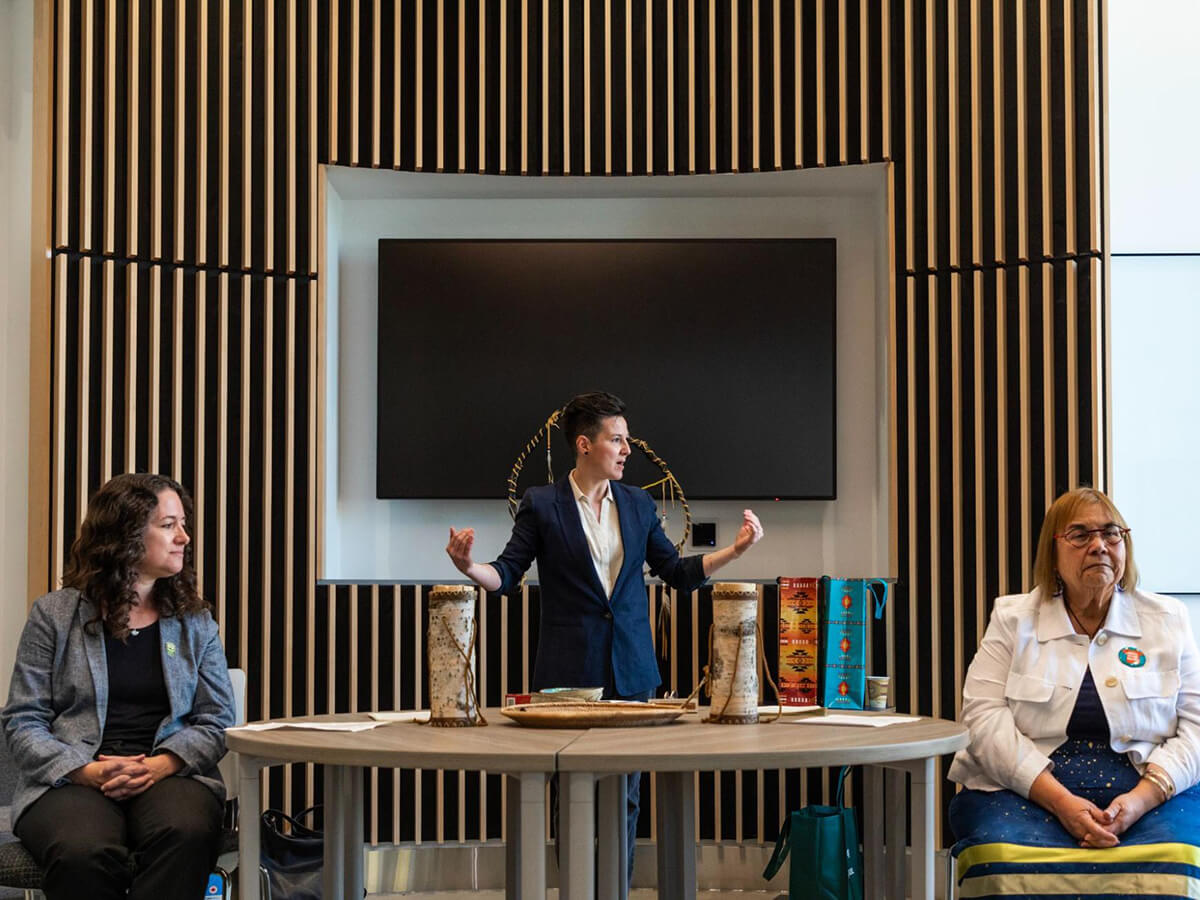
On September 23, 2024, a ceremony was held where copies of the signed Data Sovereignty Declaration and Care Taking Directives were placed in two birch bark satchels and officially passed the caretaking responsibilities to the principal investigator, and the university librarian, as the University of Alberta’s data curators. This ceremony represents a unique and historical moment because it moved the university towards a way in which Indigenous data sovereignty can be practiced. It also opened up pathways for not only academics but also, and more importantly, for Indigenous communities and Nations to safely archive the digital recordings of their Elders without compromising their inherent rights and sovereignty. As Elders pass away and take their knowledge with them, it cannot be overstated how critical it is for postsecondary institutions to collaboratively step in and practice good relations by providing digital archiving services without the costly design and maintenance fees that too often make such paramount services unaffordable for Indigenous communities and Nations.
In the words of Elder Dr. Elmer Ghostkeeper, “Digital archiving Elders’ knowledge and wisdom is key to preserving data sovereignty for generations to come.” The path established at the University of Alberta is already making a significant impact beyond its original academic purpose, with Frog Lake First Nation now actively archiving their digital recordings in Aviary using a community-specific version of the Data Sovereignty and Care Taking Directive agreement. As recognized by the University of Alberta, “This work represents a landmark achievement, demonstrating how post-secondary institutions can move beyond theoretical discussions of Indigenous data sovereignty and implement concrete practices.”
For more information, see https://silr.ca/ and https://library.ualberta.ca/.
Editor’s note: This is the third in a series of ARL Research & Analytics Impact Reports, which capture transformative effects of specific research library programs on students, researchers, communities, and/or the higher education/research enterprise. For more information about the Impact Reports series, contact Kevin Borden, senior director, Research and Analytics, ARL.