

Last Updated on September 30, 2025, 4:10 pm ET
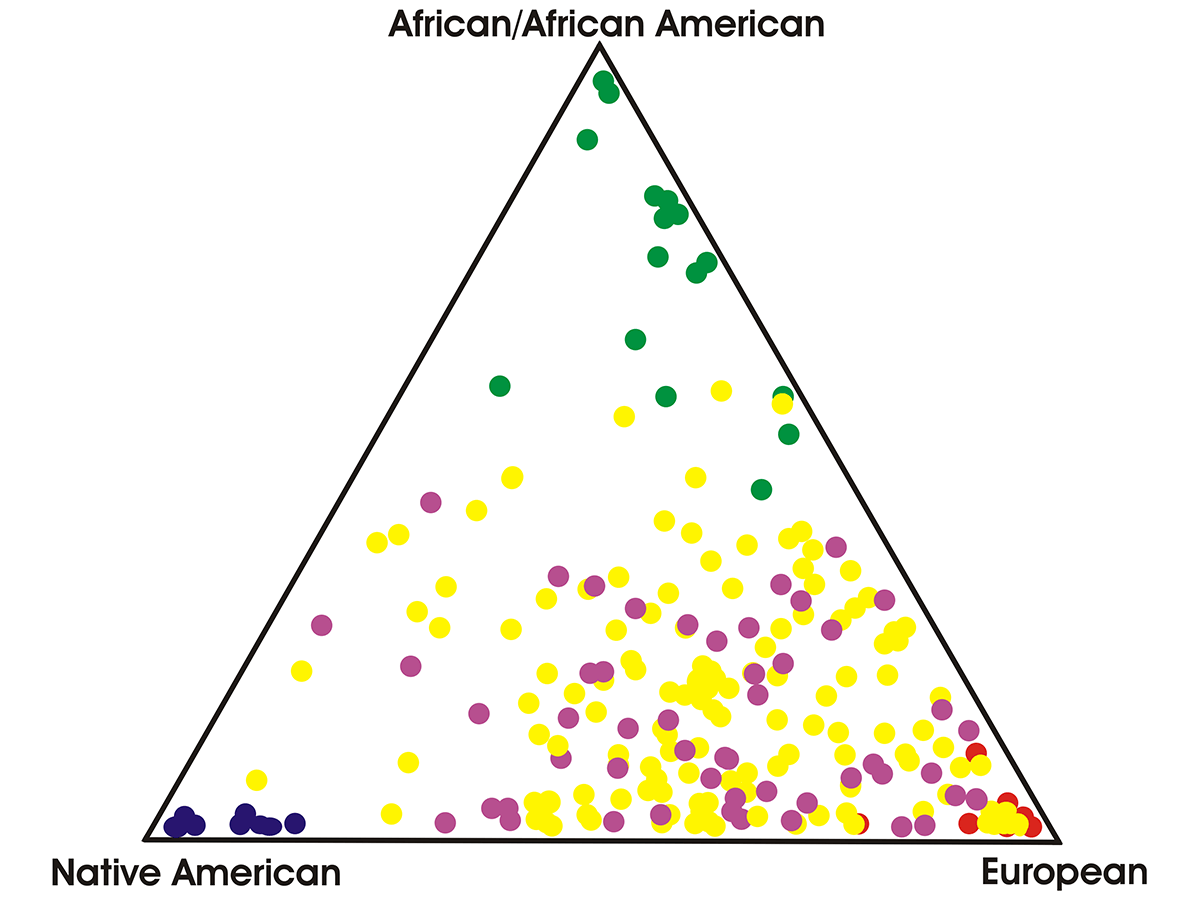
Fifty years have come and gone since the discovery that there is more genetic variation within races than between them. Yet a recent book by anthropologist of science Duana Fullwiley shows that the early 21st century marked a contentious moment when “race was being granted a new lease on biological life.” Tabula Raza: Mapping Race and Human Diversity in American Genome Science (University of California Press, 2024) explores how more diverse gene banks and next-generation sequencing techniques have paradoxically left science and society in “a stuck place”: falling back on old, harmful beliefs about racial differences, without closing the gap in health outcomes across racialized populations.
The research repertoire described in Tabula Raza hinges on the identification of ancestry-informative markers, changes in the genetic sequence shared by all humans that are more frequently found in one group than in others. Co-occurring sets of these markers are used to link individuals to a common ancestral population, often expressed in terms of the continent from which it issued. Here, ancestry is redefined as a statistical phenomenon rather than a genealogical link to particular forebears. It is also framed as fractional, with a technique called admixture mapping used to explain differences in disease prevalence in terms of the relative contribution of different genetic stocks.
Fullwiley acknowledges that minoritized researchers in this area are often motivated by a genuine concern for the health of their communities. Yet Tabula Raza shows these researchers wrestling with how their chosen repertoire ends up recycling “imagined continental essences” at odds with their own senses of self. Meanwhile, the prospect of personal genome scans has held out the possibility of moving beyond race as a proxy for genetic difference. But the open-source ethos of one initiative profiled by Fullwiley proved to be an uneasy fit for participants of color with heightened concerns about state surveillance and health insurance denial.
By interweaving direct observation at several labs with examples drawn from the literature, Tabula Raza highlights the range of sources to which geneticists turn for usable data. Fullwiley’s particular interest is in commercial ancestry testing, which allows consumers to trade their genetic data (often then resold to third parties) for a report on the geographical origins of their DNA. Toward the end of the book, one of Fullwiley’s interviewees reflects on the cultural addiction to ancestry that has helped drive the multibillion-dollar valuation of the genetics and genomics industry. Another, a Black writer who came to regret going through with the testing, notes that it’s like her ancestors “are being sold all over again.”
Takeaways for Library Leaders
Tabula Raza examines how race gets encoded in the categories that structure entire fields of inquiry. The Trump administration may be using lists of keywords to target research grants that run afoul of its crusade against “wokeness,” but studies like Fullwiley’s make it clear that legacies of racial thinking cannot be so easily excised. As experts work through these legacies in their distinctive contexts, libraries can encourage the scholars they support to adopt community guidelines like the National Academies of Science’s best practices on the use of population descriptors, referenced in Tabula Raza and increasingly expected by publishers of genetics and genomics research. Libraries can also continue their efforts toward reparative and inclusive description, recognizing that the information structures they create are important to revisit for the differences they naturalize.
Tabula Raza further demands a reckoning with the downstream effects of data collection, as with the inclusion of ancestry testing data in forensic databases given a criminal justice system that disproportionately incarcerates racialized defendants. “People should know the myriad ways in which their information can and will be used,” Fullwiley writes against the backdrop of court cases underscoring that research participants sometimes do not have this knowledge. Libraries consulting on the creation of data management plans can help advise scholars about the range of approaches to securing consent and managing access, balancing default preferences for open sharing and liberal reuse against the need for what Fullwiley calls “firewalls of care.”
Beyond the realm of genome science, Tabula Raza invites reflection on the multifarious and sometimes troubling uses to which scholarship can be put. Today, libraries are developing specialized roles to document and enhance the societal impact of the research they support. It’s not hard to imagine these positions being organized around burnishing individual and institutional reputations, especially at a moment when the imperative to demonstrate value is more urgent than ever. But libraries can protect their integrity by developing research impact services that retain a critical outlook, tracing the diverse forms of uptake that ideas can have while leaving room for a searching evaluation of the ends they achieve.