
Last Updated on July 9, 2025, 8:26 am ET

The Association of Research Libraries (ARL) convened in Minneapolis, Minnesota, at the end of April. Attended by the member representatives of its 125 member libraries and invited guests and speakers, Association Meetings are twice-yearly opportunities for research library leaders to meet in person to advance the strategic priorities of ARL, to interact with experts from adjacent spaces in the knowledge sector, and to learn from and with each other as peers. In what proved to be prescient for the current political moment, the 2025 Association Meeting Program Planning Task Force chose the theme of trust for this year’s meetings.
As public confidence in trusted institutions like higher education, science, media, civic institutions, and digital spaces continues to erode, research libraries are uniquely positioned to play a proactive role in addressing these challenges. Through panel discussions and breakout conversations, the 2025 Association Meeting underscored how research libraries can strengthen public trust in information and the research enterprise, contributing to better public policy, improved social outcomes, and access to knowledge. Expert speakers on public trust in science, confidence in higher education and memory institutions, and global trends in trust across key sectors joined the meeting and shared their insights.
ARL President Rhea Ballard-Thrower, University of Illinois Chicago, opened the 186th Association Meeting with warmth and candor. Before beginning the formalities of convening the nearly 100-year-old association, Rhea asked the attendees to “turn to the person next to you and tell them you’re glad they’re here.” In that simple gesture, she demonstrated the power of being in community. Over two and a half days in Minneapolis, in a meeting that operated under the Chatham House Rule, Association leaders, members, invited speakers, guests, and staff sustained that climate and practiced a community of trust and care.
Almost every conversation surfaced the theme that trust is relational. It can be embodied in individuals, and gained or lost in relation to the institutions they represent. In a line that reverberated through the meeting, one speaker noted that trust is “gained in drops, and lost in buckets.” A related concept was the need for trusted individuals to communicate clearly and respectfully with audiences who hold different forms of expertise and lived experience. Librarianship is highly relational and our institutions are rich with knowledge to be shared both “inside-out” and “outside-in” with partners such as cooperative extension, science communication professionals, government relations, and research offices. Effective and empathetic communication is a critical skill in these times.
Seven takeaways from the 186th ARL Meeting include:
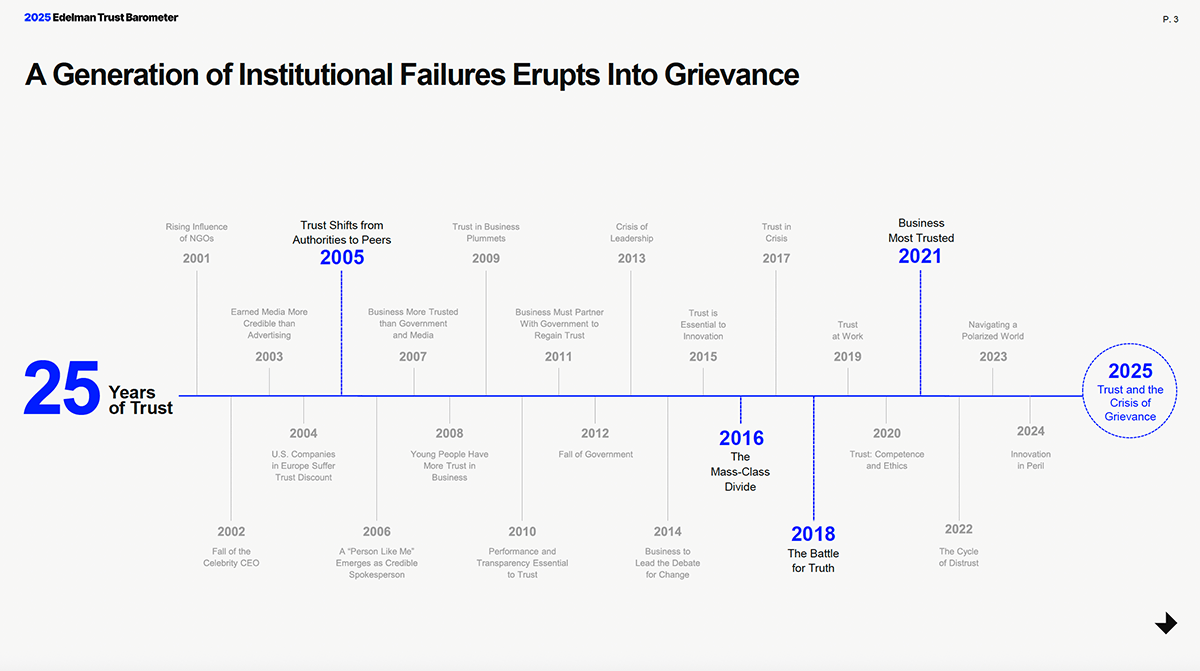
- This is a crisis moment for the truth. Tess Peterson, VP of Thought Leadership Research at the Edelman Trust Institute, presented findings from the 2025 Edelman Trust Barometer, released this past January for its 25th annual cycle. The current truth/information crisis, while preceding the COVID-19 pandemic, was almost certainly exacerbated by the ensuing social isolation and retreat from civic life. As measured in the Barometer, trust in institutions (NGOs, media, government, education) reflects both perceived competence (how well a job is performed) and ethics (to what extent are the institution’s motives in the public interest). It is this question of motives that leads people to trust people they know—friends, family, peers, respected community influencers—to have their best interests at heart. There are tremendous lessons and opportunities in this insight for libraries and higher education.
- Knowledge institutions change lives. Public libraries in particular have leveraged the trust they have built in communities to provide a safe and welcoming environment. In the past five to ten years, they’ve extended social services that patrons have asked for and can be provided in a context of a privacy-protecting information-seeking environment. Information services related to employment, immigration, and mental health, for example, can be transformative for library users. Directors of large urban library systems, as well as presidents of research universities, spoke about the need to tell stories of community enrichment and mobility—untethered from a particular political affiliation or position—directly related to the knowledge institutions they lead.
- There is more opportunity than ever in guiding people in their information seeking. If there is a battle for truth, libraries play a critical role in guiding people to reliable information to address their curiosity, wherever they may start this journey. This requires patience, humility, empathy, and the ability to listen with respect. Panelists in a forum on “Trust in Science” highlighted the role of peers (such as fellow students), near peers (graduate students and undergraduates), and influencers whose motives are presumed to be trustworthy. Reaching trusted individuals within a community can help reach many more.
- There is enthusiasm and innovation around AI in libraries. The library community continues to pursue AI with a focus on strategic vision and innovation. A breakout session on AI and the library workforce packed the room. Despite very real challenges in budget, session facilitators shared that ARL libraries are making substantial investments in their AI future: an impressive two-thirds have secured AI subscriptions, and 22% have already created dedicated AI positions. Libraries are carving out an essential campus role in advancing AI literacy as both leaders and conveners by offering instruction, physical and digital spaces for collaboration and experimentation for navigating AI’s ethical implications, mitigating bias, and maintaining information integrity. Professional development likewise is flourishing through diverse approaches—from self-directed learning initiatives to increasingly formalized training programs. This multi-faceted strategy ensures that library professionals can engage with AI at their own pace while building institutional expertise. Challenges persist around staff anxieties, environmental concerns, and public skepticism, but AI is increasingly viewed as a tool to enhance, not replace, library expertise.
- Transparent communication is key to trust in leadership—especially now. Kent State University President Todd Diacon and University of Manitoba President Michael Benarroch talked about the manner and frequency of communicating to students, faculty, and staff and the wider communities in which they serve, even when their information is incomplete or uncertain. Communicating uncertainty was a challenge during the pandemic that had lasting repercussions for trust in government. A store of trust, built through frequent and honest communication, can buy goodwill when institutions make mistakes—which they inevitably do. Admitting those mistakes is critical.
- Preserving the scientific record will take new stewardship relationships. A breakout discussion on the disappearing scientific record surfaced urgent concerns about the fragility of public data access, especially in the face of administrative change, privatization, and global conflict. Since the end of January 2025, libraries have reflected on their role in data preservation and access to public data. Key questions include how to prioritize what to rescue, how to maintain long-term access, and how to mobilize collective infrastructure and funding amid resource constraints. Participants voiced concern about the politicization of data (for example, climate data, child poverty data), risks to researchers and vulnerable populations, and the limits of federal agency stewardship. Emerging themes included leveraging international partnerships, collaborating with professional societies, and reframing “federal” data as “public” to reinforce its communal value. Stories from the field underscored grassroots innovation, from data-rescue trackers to libraries as conveners, and to anchor efforts in civil society rather than fragile federal structures.
- Library leaders need to be even more comfortable with sustained ambiguity. The ARL Learning Network Committee and the Member Engagement and Outreach Committee held open conversations on what staff need and what leaders need at this moment. The consensus? Libraries need to develop a stronger capacity to navigate ambiguity as they lead transformational change. This includes cultivating the ability to make decisions without having all the information, embracing risk-taking, and learning to “dive off the cliff” without a fully formed plan. Ambiguity demands resilience, flexibility, and the emotional intelligence to manage uncertainty while supporting others through it. Library leaders must become comfortable with situational awareness, iterative problem-solving, and the skills required to build trust in evolving contexts. Embracing ambiguity also involves reframing organizational roles, articulating new directions clearly, and maintaining a forward momentum even when outcomes are not guaranteed. The consistent practice of synthesizing diverse input, documenting decisions, and advocating for the public good amid uncertainty is key to thriving in this moment.
ARL will continue pursuing the trust theme in its Fall 2025 Association Meeting, engaging experts in museums, technology, publishing, and more.
See also: Marcel LaFlamme, “Partnering Across the Research Enterprise in These Times,” ARL Views blog, May 30, 2025.