
Last Updated on March 25, 2026, 12:31 pm ET
The 2026 Association of Research Libraries (ARL) President’s Institute convened in Chicago-Rosemont on February 11–12 at a time when questions of stewardship, leadership, and institutional responsibility feel especially urgent for research libraries. Centered on the theme “Unlock Innovation,” the institute invited library leaders at all levels to explore what innovation truly means for research libraries today—not as a fleeting trend, but as an intentional process grounded in collaboration, creative problem-solving, and sustainable change. As the 2026 Julia C. Blixrud Scholarship recipient, I had the opportunity to participate in these conversations firsthand.
After a brief networking lunch, ARL President Melissa Just (13LFP Fellow), dean of libraries at the University of Southern California, opened the institute with a land acknowledgment recognizing the Indigenous peoples of the Chicago area, including the Council of the Three Fires—the Ojibwe, Odawa, and Potawatomi Nations—along with the Miami, Ho-Chunk, Menominee, Sac, Fox, Kickapoo, and Illinois Confederation peoples. She framed the acknowledgment as a reminder of librarians’ responsibilities as stewards of knowledge and memory, encouraging reflection on whose histories are preserved and whose voices remain absent from the record.
This emphasis on responsibility and inclusion was reflected not only in the opening remarks but also in the structure of the event itself. Early in the program, participants were invited to scan a QR code to access StreamText, which provided real-time captioning for all speakers throughout the institute. I also noticed a sign language interpreter present at the front of the room. As someone who personally relies on captions and is professionally committed to accessibility, I greatly appreciated this effort, ensuring that participants like me could fully participate in the conversation. This small, but thoughtful and intentional, gesture reminded me of how libraries can lead the way in paving a path toward greater equity and inclusion—values that are central to our profession.
As the opening remarks concluded, the institute launched into its first workshop session, facilitated by M.J. D’Elia (16LFP Fellow), founder of Thirdway Think and a former academic librarian at two ARL institutions (British Columbia and Guelph), and Helen Kula (25ILP Fellow), associate university librarian for teaching and learning at McMaster University. Drawing on their extensive leadership and innovation experience in libraries, the facilitators introduced participants to the Double Diamond Innovation Framework, a design model popularized by the UK Design Council that moves between divergent and convergent thinking as teams first explore and define a problem before developing and testing potential solutions.
The first workshop focused on the framework’s “Problem Space,” guiding participants through the Discover and Define phases. Rather than jumping immediately to solutions, we were encouraged to spend time unpacking challenges facing our institutions and the broader research library landscape.
As part of the Discover phase, participants shared brief “rocket pitches” describing innovation challenges or opportunities they hoped to address, which then served as starting points for team formation and deeper discussion.

I decided to pitch my own challenge to the room. Although speaking in front of roughly 150 participants felt daunting, as someone committed to continually growing as a professional, I always try to take opportunities like this to challenge myself. Innovation, after all, often requires stepping beyond our comfort zones.
In particular, I raised questions about what I think of as academia’s “PDF culture.” Even when carefully remediated, PDFs can remain difficult to access for many users. I wanted to explore how research libraries might lead broader cultural change across campuses so that accessibility becomes a default mindset rather than a reactive fix.
After the pitches concluded, participants gathered around the challenges that resonated most with them to form teams. I was excited to find several colleagues interested in exploring accessibility alongside me, and we formed a group to further unpack the issue. Together, we discovered our own institutional experiences with inaccessible formats, shared frustrations and insights, and asked clarifying questions to deepen our understanding of the challenge.
Transitioning into the Define phase, teams worked to synthesize their conversations and identify common themes. One of the tools introduced during this stage was the “How Might We” question, a technique that frames challenges in an action-oriented (“How”), exploratory (“Might”), and collective (“We”) way.
After reflecting on our earlier discussions, our team ultimately arrived at the question: How might we embed digital learning object accessibility as a meaningful practice in library culture? This question helped us move from a broad concern toward a more focused challenge that we could begin exploring further in the solution-focused workshop the following day.
Building on the day’s workshop discussions, participants gathered for the Julia C. Blixrud Memorial Keynote Lecture by Lee Vinsel, associate professor of science, technology, and society at Virginia Tech and coauthor of The Innovation Delusion. Rather than celebrating innovation for its own sake, Vinsel challenged participants to think critically about the difference between actual innovation and “innovation-speak,” cautioning against an uncritical obsession with novelty, disruption, and hype. His emphasis on maintenance, care, and the labor of sustaining systems felt especially resonant in a library context, where so much essential work depends not only on new ideas, but on long-term stewardship and support.
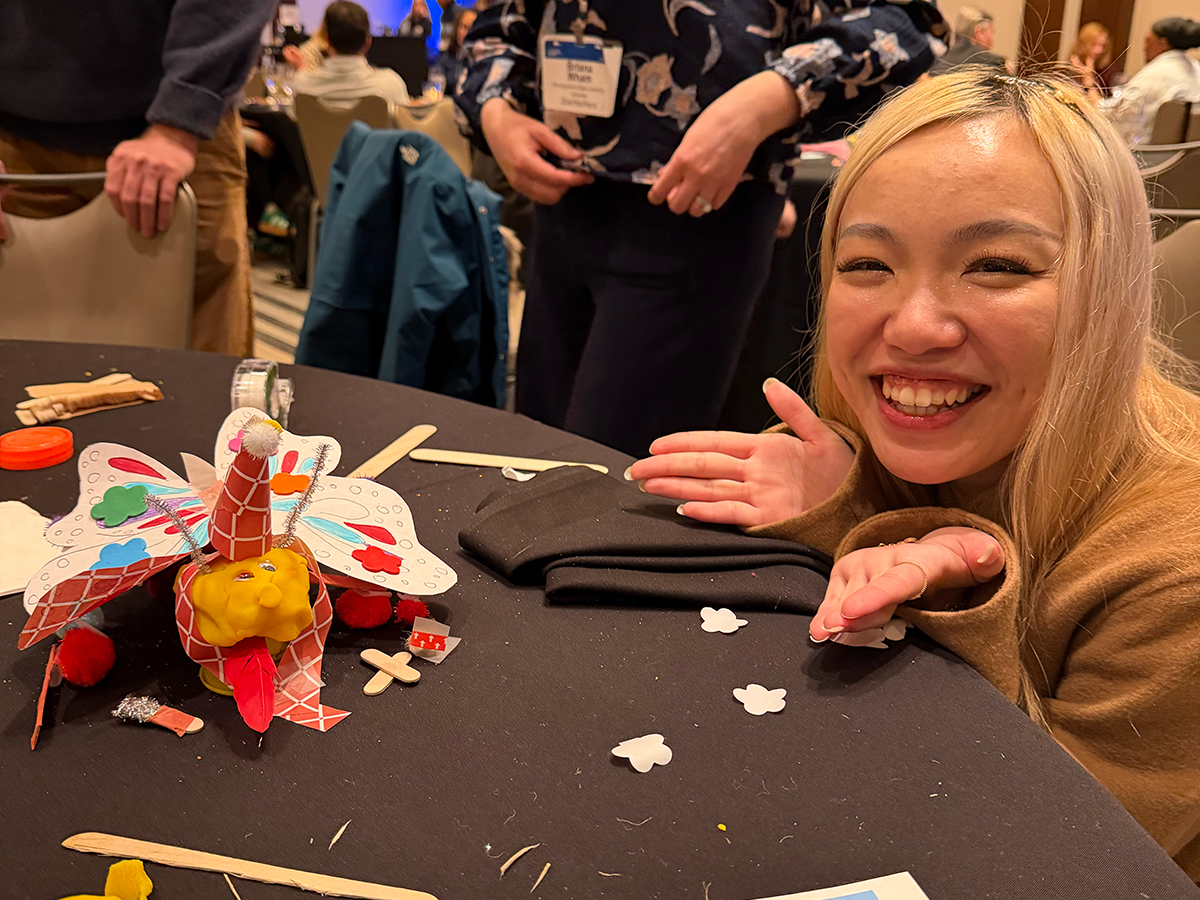
Day one concluded with an evening “Dinn-o-vate” experience, a lighthearted dinner activity sponsored by Elsevier where participants were challenged to build collaborative “innovation creatures” from craft supplies. It was a fun reminder that innovation can sometimes begin with markers, pipe cleaners, and a bit of imagination.
The following morning, participants reconvened for day two of the institute with the second Julia C. Blixrud Memorial Keynote Lecture, delivered by Masud Khokhar, chief digital and information officer at the University of Leeds. If Vinsel challenged participants to think critically about “innovation-speak” and the importance of maintenance, care, and long-term stewardship, Khokhar offered a more pragmatic perspective on what it takes to embed innovation into everyday organizational practice. Rather than treating innovation as a one-time initiative, he emphasized the structural and cultural shifts needed to sustain it over time—moving from outputs to outcomes, from projects to products, and toward more adaptive approaches to prioritization and leadership.
Following the keynote, participants returned to the Double Diamond framework by moving into the “Solution Space,” which focused on the Develop and Deliver phases. M.J. D’Elia and Helen Kula reminded us that innovation is human, iterative, messy, and multimodal—qualities that felt especially relevant as we shifted from defining problems to generating and testing possible solutions. If day one was about solving the right problem, day two challenged us to begin finding the right solution.
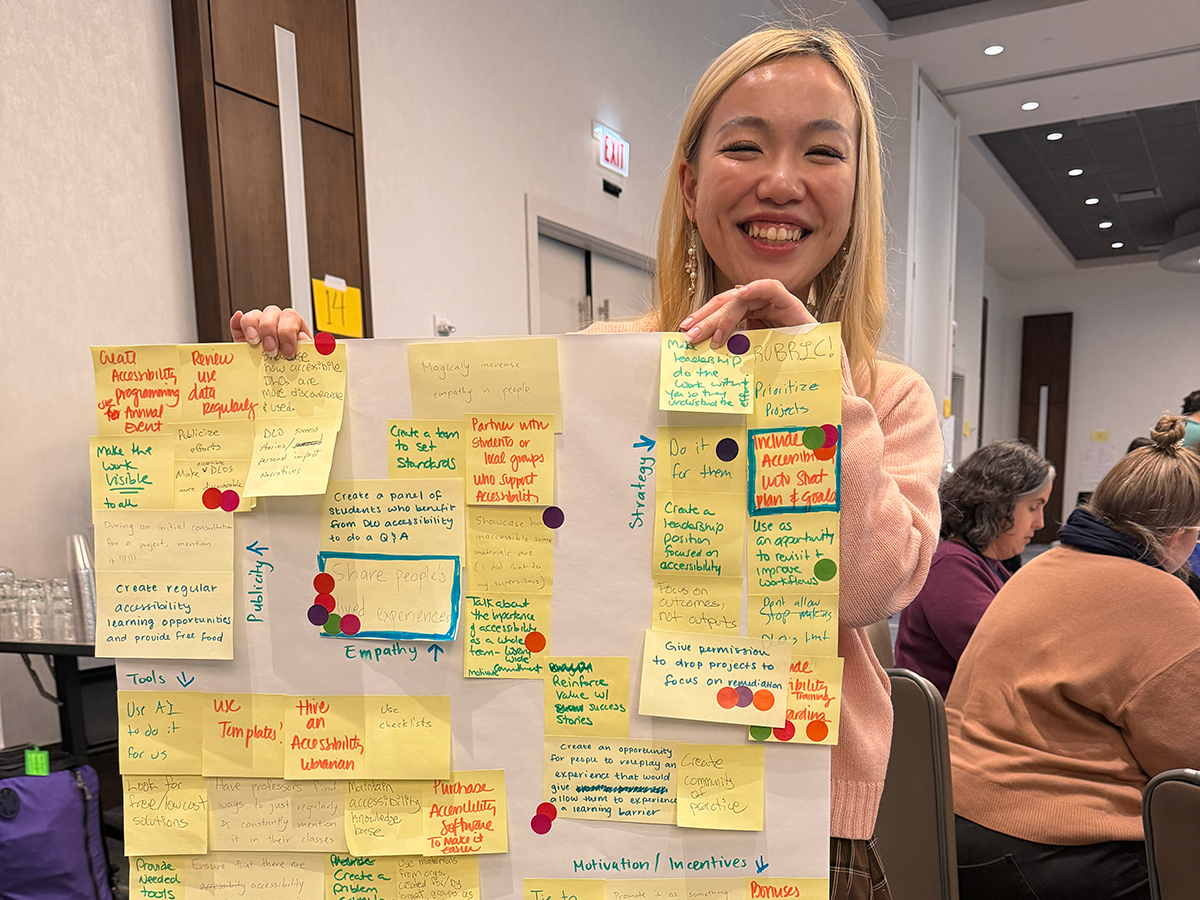
The Develop phase began with ideation. Starting from our team’s “How Might We” question, we moved back into divergent thinking through a rapid “Stick ’Em Up” brainstorming exercise, in which participants wrote ideas on sticky notes, voiced them to their tables, and built on one another’s suggestions. To help spark additional ideas, the facilitators also introduced prompts from the SCAMPER method, encouraging teams to substitute, combine, adapt, modify, or rethink existing ideas. In a matter of minutes, my group generated more than 60 sticky notes! A vivid reminder that solution-building often begins not with a single polished answer, but with an energetic flood of possibilities.
After generating such a wide range of ideas, the workshop then shifted back again toward convergent thinking. Teams reviewed their sticky notes, clustered related ideas together, and began narrowing the field. Using a simple dot-voting exercise—sometimes called “dotmocracy”—each participant voted on the ideas they felt seemed most promising. Through this process, teams gradually moved from dozens of brainstormed ideas toward a small set worth exploring further.
With several promising directions identified, the workshop then transitioned into the Deliver phase of the Double Diamond framework. Here, teams were encouraged to think about how their ideas might be tested through small, practical prototypes. Drawing on a “Build–Measure–Learn” approach, the facilitators asked participants to consider what they hoped to learn from a prototype, how they might measure its impact, and what kind of simple experiment could help move the idea from concept toward implementation. Rather than aiming for a fully polished solution, the focus was on developing early, testable versions of ideas that could generate feedback and guide future iterations.
For our group, the promising idea we chose to prototype centered on sharing people’s lived experiences as a way to shift how the broader campus community thinks about digital learning object accessibility. Rather than framing accessibility primarily as a compliance requirement, we discussed how storytelling and personal perspectives might help make it more meaningful for those creating materials across campus. By emphasizing how accessible design improves the quality of one’s own work and impacts real users, the goal is to foster a stronger sense of personal ownership, accountability, and empathy around accessibility practices.
During the final share-out, the room opened up for participants to share their team’s prototype ideas. Once again, I found myself stepping up to the microphone—this time to present our group’s prototype: a three-part speaker series designed to center lived experiences and spark broader conversations about accessibility across campus. Using the Build–Measure–Learn approach introduced during the workshop, we proposed testing whether storytelling could be an effective way to build empathy and buy-in around accessibility. The series would help us learn what motivates people to engage with accessibility practices and which types of stories resonate most, while measuring impact through participant feedback and potential increases in accessibility training enrollment or remediation requests.
Like the day before when I pitched the original challenge, the moment felt both nerve-wracking and energizing. It was incredibly rewarding to see how the idea I pitched had evolved through the workshop process, growing from a single question about accessibility culture into a tangible prototype shaped through collaboration, brainstorming, and reflection.
As the institute came to a close, I found myself reflecting on what made the experience so meaningful. Throughout the two days, participants sat side by side without titles on our name badges—meaning we never quite knew whether we were speaking with a new librarian, a seasoned practitioner, or even a library dean. What quickly became clear, however, was that everyone in the room shared the same genuine commitment to tackling the complex challenges and opportunities facing research libraries.
The conversations reinforced something that often feels central to our field: meaningful change in libraries is rarely the work of one person. Addressing large-scale cultural or institutional challenges requires collaboration, shared perspectives, and a community willing to work through ideas together. I left the institute energized by the creativity and thoughtfulness of the people in the room, reminded that even the most ambitious changes begin through collective effort. The experience was a powerful reminder that innovation in libraries is rarely about a single breakthrough moment; rather, it is sustained through the everyday work of listening, experimenting, maintaining, and learning from one another.
I am deeply grateful to ARL for organizing this year’s President’s Institute and for the opportunity that the Julia C. Blixrud Scholarship allowed me to include my voice at the table. I also want to thank my team members, who were willing to build on my initial pitch and explore the accessibility challenge together. I look forward to carrying these insights forward as I continue working to unlock innovation in accessibility across research libraries—moving beyond compliance and the bare minimum toward a culture where accessibility is embraced as a shared responsibility.
Editorial note: ARL awarded Christine Thuy Minh Nguyen the Julia C. Blixrud Scholarship to attend the 2026 ARL President’s Institute. Christine is a master of science in library and information science (LIS) student at the University of Illinois Urbana-Champaign, specializing in digital archives and data stewardship. She currently serves as a graduate assistant in the Research Data Service Unit of the University of Illinois Library, where she has developed a strong commitment to inclusive user experience and accessible digital design by leading a project to innovate change in current technical workflows.