
Last Updated on October 28, 2025, 1:04 pm ET
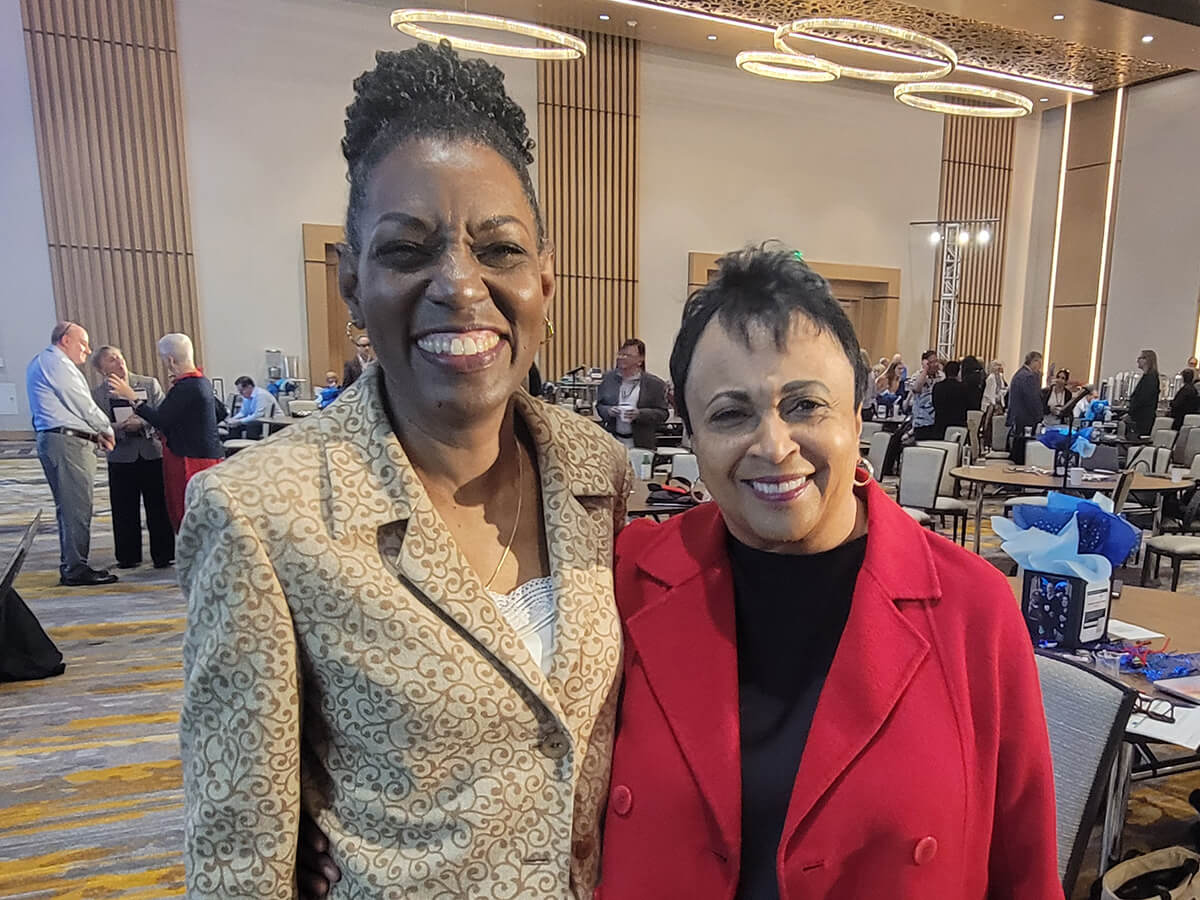
The Association of Research Libraries (ARL) convened in National Harbor, Maryland, earlier this month. Attended by the member representatives of ARL’s 125 member libraries, 65+ participants in ARL’s Leadership and Transformation programs, and invited guests and speakers, Association Meetings are twice-yearly opportunities for research library leaders to meet in person to advance the strategic priorities of ARL, to interact with experts in the knowledge sector, and to learn from and with one another as peers. The meetings operate under the Chatham House Rule to encourage open conversation.
Continuing to explore the theme of trust launched at the Spring 2025 Association Meeting, this meeting featured conversations with publishers; national library, museum, and archives leaders; and vice presidents for research. ARL committees sponsored breakout sessions on trust indicators in scholarly communication, working with government affairs on campus, and innovative potential futures of ARL’s Research & Analytics and Learning programs. Members, fellows, and guests also discussed the difficult realities ARL members are facing with respect to reductions in force and federal, state, and local policy restrictions on DEI language and work—conversations made imminently more productive through trusted association with peers. In a signal of the enduring importance of associations, at its Business Meeting, the membership voted in its 126th member library—Clemson University.
ARL President Rhea Ballard-Thrower (University of Illinois Chicago) opened the 187th Association Meeting as presidents of the Association have since 2019—with a land acknowledgement. This year, President Ballard-Thrower deliberately parsed the scripted statement and emphasized the importance of associated action—announcing that ARL has entered into a new partnership with the American Indian Library Association (AILA) through a donation to AILA and a commitment to future collaboration and the ongoing integration of Indigenous voices, perspectives, and partnerships in meaningful ways. Ballard-Thrower also took some time to acknowledge and warmly welcome the cohorts of leadership fellows in the room who had just completed their 2025 Learning Summit, as well as the scores of sitting deans and directors who are graduates of those programs. More than 1,000 alums of ARL’s cohort programs have collectively transformed the leadership of our profession.
Key takeaways from the 187th ARL Meeting include:
- We need to think differently about expertise, influence, and trust. In conversation with María Estorino (UNC Chapel Hill), Holden Thorp (Science) opened the program with some reflections on the past tumultuous year. Advocating for a more distributed approach to science communication, Thorp suggested that professors speaking on television or in op-ed pages might not be the most effective strategy to reach a skeptical public. Rather than relying on ourselves to solve the trust problem, we need to work with community leaders—people who have more trust and credibility in the public eye than we do. Public libraries can be an important piece of this strategy, as can faith leaders, local newscasters, agricultural extension agents, and locally elected officials. Research libraries often have extensive local connections within their institutions and their communities and can play a bridging role for knowledge mobilization.
- Creating and stewarding scholarship as public service builds trust. As part of a panel of university vice presidents for research, Arthur Lupia (University of Michigan) joined us to talk about restoring trust in the research enterprise. Along with moderator Sarah Shreeves (University of Utah) and co-panelists Leah Cowen (University of Toronto) and Stacie Bloom (NYU), this session explored the paradox of trusting experts, such as one’s own physician, while being suspicious of the interests those experts serve. It’s vitally important that researchers, librarians, and everyone in the research enterprise see and represent ourselves as working in public service—our credibility depends on it.
- Universities are under attack and need to keep doing what we do best: educate, research, encourage dialogue, operate globally. Challenges to universities right now are myriad—ranging from immigration policy, coercive restrictions on speech and academic freedom, and new conditions on grants and federal funding. Despite these challenges, universities still engender greater trust than other sectors of society. Committing to our core missions and functions is essential—as is maintaining our integrity—to maintaining that trust.
- Trust internally is necessary to build trust externally. Institutions and organizations that hold the public trust need to build reservoirs of trust internally to navigate difficult moments. Carla Hayden (Mellon Foundation and formerly Library of Congress) spoke about the relationship between internal trust-building and institutional resilience. In a sentiment that surely resonated in a room of executives, sometimes leaders have to move fast and make decisions with less consultation than we’re used to. Leaders maintain trust in those instances if, in calmer times, they share information transparently.
- Interest in authentic materials in libraries, museums, and archives is increasing, presenting incredible opportunities for engagement. We had the opportunity to hear Carla Hayden (Mellon Foundation), Leslie Weir (Library and Archives Canada and IFLA), and Louise Mirrer (New York Historical), in conversation with each other and with moderator Sarah Thomas (ARL past president 2004). In a wide-ranging panel discussion of what it means to hold the public trust, each agreed that the public—especially youth—are craving authentic, truthful evidence. From mass proliferation of fake news to the popularity of the TV series The Gilded Age, there is renewed interest in artifacts and documents of the past.
- The majority of ARL libraries either have or are working on principles or best practices for the ethical use of AI. Leo Lo (University of Virginia) and Natalie Meyers (ARL/CNI) presented trend data on ARL libraries on a number of engagement dimensions with AI. In a live poll of the audience in attendance, 65% of libraries said they either already had or are working on best practices for the ethical use of AI.
- The present moment requires more unity and less competition. Collective action for universities is undermined by competition. Examples of the current renegotiation of the relationship between government and higher education can be seen in the anticipated new US federal guidance on indirect cost recovery for research investments and the proffered “campus compact.” In the face of an organized and coordinated effort by the Trump administration, higher education would do well with more unity and less competition.
After the meeting concluded, attendees were welcome to stay for an evening film screening of the documentary Join or Die, followed by a Q&A with the creators, Pete and Rebecca Davis. The next day, 75 research library deans and directors—including 21 from research library consortia adjacent to ARL—stayed for ARL’s Executive Institute on libraries, democracy, and civic engagement.